Tooth Replacement Options in Beverly Hills: A Complete Comparison Guide

By Dr. Vivian Roknian, DMD Losing a tooth changes more than your smile. It shifts how you chew, how you speak, and quietly, how you carry yourself in a room. If you’re weighing your options in Beverly Hills or the greater Los Angeles area, the decision is more layered than most dental websites let on.

What Are the Tooth Replacement Options in Beverly Hills?

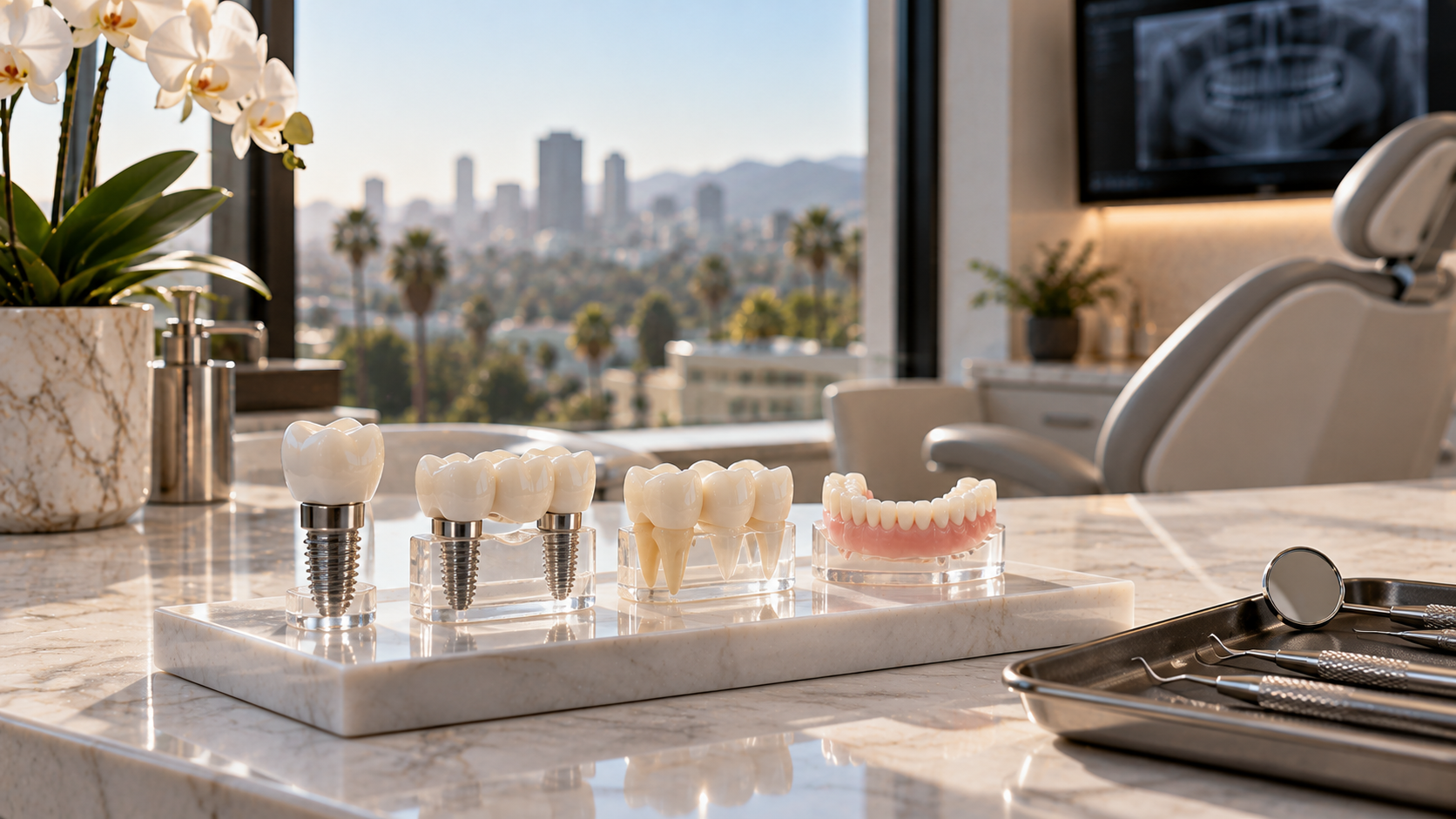
Tooth replacement options in Beverly Hills include dental implants (single, multiple, or full-arch), implant-supported bridges, traditional fixed bridges, removable partial dentures, and full dentures. Dental implants are the only option that replaces the tooth root, preserving jawbone density over time. The right choice depends on bone volume, the number of missing teeth, overall health, and long-term goals.

Key Takeaways

  • Dental implants are the only tooth replacement that prevents jawbone loss because they stimulate the bone the way a natural root does.
  • Full-arch implant solutions like All-on-X replace an entire jaw with four to six implants, making them a fixed alternative to dentures.
  • Bone volume determines which options are available to you before anything else is decided.
  • Patients on GLP-1 medications, those who’ve had cancer treatment, or those who’ve had weight loss surgery require a modified evaluation before implant placement.
  • A second opinion from a board-certified implantologist is worth getting before committing to any irreversible procedure.

Why Does the “Best Option” Vary So Much From Person to Person?

The answer most websites give you is a clean hierarchy: implants are best, bridges are second, dentures are last. That framing is too simple, and it skips the variables that actually change the answer. The real deciding factor isn’t the tooth. It’s the bone underneath it. When a tooth is lost, the jawbone beneath it begins to resorb because it no longer receives stimulation. A bridge spans the gap but leaves the bone untouched. A denture rests on the gum surface. Only an implant transmits chewing force into the bone, which is why implants are the only option that actively prevents the bone loss that makes future tooth replacement harder. This is the mechanism most comparison articles skip. The choice you make today shapes the options you’ll have in ten years.

What’s the Actual Difference Between Each Option?

Here’s a side-by-side comparison of the most common tooth replacement approaches, framed around what each one does and doesn’t protect:  
Option Replaces Root? Preserves Bone? Removable? Adjacent Teeth Affected? Typical Longevity
Single dental implant Yes Yes No No Decades with proper care
Implant-supported bridge Partially Partially No No Long-term
Traditional fixed bridge No No No Yes (filed down) 10-15 years average
Implant-supported denture Yes Yes Varies No Long-term
Full removable denture No No Yes No 5-8 years before refit
Partial removable denture No No Yes Yes (clasps) 5-10 years
The column that matters most to most patients isn’t longevity. It’s “adjacent teeth affected.” A traditional bridge requires grinding down two healthy teeth on either side of the gap to create anchor points. Those teeth are permanently altered. If you’re 40 years old and otherwise healthy, that’s a significant trade-off to accept when an implant avoids it entirely. You can explore the functional and cosmetic benefits of dental bridges to understand when that trade-off might still make sense for your situation.

Who Actually Qualifies for Dental Implants, and What Changes That Answer?

Most adults in good general health qualify. But “good general health” is doing a lot of work in that sentence. Several specific conditions change the evaluation: Bone volume. If significant bone loss has occurred since the tooth was lost, a bone graft may be needed before implant placement. This adds time to the process but doesn’t disqualify you. At Implant Dentistry by Doc Rok, 3D-guided imaging is used to assess bone density and map implant placement before a single incision is made. You can read more about how 3D-guided implant technology works in Beverly Hills and why it changes the accuracy of placement. Active gum disease. Placing an implant into a mouth with untreated periodontal disease is one of the most predictable ways to cause implant failure. The infection doesn’t stay contained. If you have gum disease, it needs to be treated first, often with LANAP laser periodontal therapy, before implant candidacy can be properly assessed. Systemic health factors. Patients who’ve had radiation to the jaw, those currently on certain medications, or those managing autoimmune conditions require a more careful pre-surgical evaluation. This is a category where the standard checklist isn’t enough. One scenario worth knowing about: patients who’ve had significant weight loss surgery often experience nutritional deficiencies that affect bone density and healing. The same is true for patients who’ve been on GLP-1 medications for an extended period. If that applies to you, the connection between GLP-1 medications and dental implant outcomes is something your provider needs to account for before treatment begins, not after. If you’re at this stage of research and want a clear picture of where you stand, the most useful next step is a consultation that includes imaging. Not a phone call. Not a quote. An actual evaluation. Schedule a consultation at Implant Dentistry by Doc Rok to get a treatment plan built around your specific bone structure, health history, and goals.

What If You’re Missing All or Most of Your Teeth?

Full-arch replacement is a different category than single-tooth replacement, and it deserves its own answer. All-on-X are implant-supported systems that replace an entire arch (upper, lower, or both) using four to six strategically placed implants. The final restoration is a fixed prosthetic, meaning it doesn’t come out at night. It functions like natural teeth. The contrarian reality of full-arch implants: most people who’ve been told they need dentures are actually candidates for a fixed implant solution. The assumption that full tooth loss means dentures is outdated. The real question is whether enough bone remains to support implants, and in many cases, the implants can be angled to use available bone even where density has declined. For patients who currently wear dentures and want to know whether conversion is possible, the full dental implant services page covers what the evaluation process looks like and what the transition involves.

What About Cosmetic Concerns Alongside Tooth Replacement?

Many patients coming in for tooth replacement also have concerns about the appearance of their remaining teeth. This is where the distinction between a dental implant practice and a full cosmetic practice matters. A single implant placed next to discolored or worn natural teeth creates a visible mismatch. The implant crown is fabricated to match your existing teeth, but if those teeth don’t reflect the smile you want, the result is a technically successful implant in an aesthetically incomplete smile. The most satisfying outcomes combine tooth replacement with a broader smile transformation plan. This might mean whitening or veneers for the surrounding teeth, or a full-mouth approach if multiple teeth are involved. Patients exploring these options often find that cosmetic dentistry in Beverly Hills can address the surrounding teeth alongside implant placement for a unified result. At Implant Dentistry by Doc Rok, these decisions are made together, not sequentially.

The One Mistake That Makes Every Option More Expensive

Waiting. Not because of price increases, but because of biology. Every month a tooth socket sits empty, the bone beneath it continues to resorb. What might be a straightforward implant placement today becomes a bone grafting case six months from now. If you’ve been told you need a bone graft, it’s worth understanding the signs that bone grafting may be necessary and what that process adds to your timeline. The most expensive tooth replacement decision isn’t choosing implants over a bridge. It’s delaying treatment until your options narrow.

Who Is NOT the Right Fit for Dental Implants Right Now?

Straight talk matters here. Implants aren’t the right immediate answer if you have active, untreated periodontal disease. They’re also not appropriate if you’re currently undergoing chemotherapy or radiation to the head and neck area, or if you’re a heavy smoker who isn’t willing to modify that habit during the healing period. Smoking significantly impairs osseointegration, which is the process by which the implant fuses to the bone. None of these are permanent disqualifiers for most people. But they are reasons to treat the underlying condition first. That sequencing is exactly what a thorough implant evaluation is designed to identify.

Frequently Asked Questions

How long does it actually take to get a dental implant from start to finish?

A straightforward single implant typically takes three to six months from placement to final crown, because the implant needs time to fuse with the bone before the permanent restoration is attached. If bone grafting is needed first, add another three to four months before implant placement can happen. Some cases qualify for same-day or immediate-load implants, but that depends on bone density and the specific tooth location.

Is the implant process painful?

Most patients report that the procedure itself is far more comfortable than they expected, because it’s done under local anesthesia and often with sedation options. The days following surgery involve soreness and swelling, not acute pain, and most people manage comfortably with over-the-counter medication. The anticipation is usually worse than the reality.

What happens if I already have bone loss from a missing tooth?

Bone loss doesn’t automatically rule out implants. A bone graft can rebuild the area before implant placement. The extent of the graft needed depends on how long the tooth has been missing and how much density has been lost, which is why imaging is done before any treatment plan is finalized.

Are full-arch implants really better than well-fitted dentures?

For most people, yes, and the reason is functional, not cosmetic. Fixed implant-supported arches allow you to bite with close to natural force. Removable dentures rest on the gum and shift under pressure, which limits what you can eat and accelerates bone loss beneath them. The long-term cost of dentures, including refits, adhesives, and eventual bone loss, often exceeds the upfront investment in implants.

What if I’ve already had a failed implant somewhere else?

A failed implant isn’t the end of the road. The cause of failure matters more than the failure itself. Infection, insufficient bone, and poor placement are all addressable. At Implant Dentistry by Doc Rok, patients seeking a second opinion on a failing or failed implant receive a full evaluation before any new treatment is proposed.

How do I know if my gum disease needs to be treated before I can get implants?

If you have bleeding gums, persistent bad breath, gum recession, or loose teeth, those are signs that active periodontal disease may be present. A proper evaluation will include measuring pocket depths around each tooth. Gum disease needs to be fully controlled before implant placement, because the same bacteria that destroy natural tooth roots can attack implant surfaces.

Does insurance typically cover dental implants in Beverly Hills?

Most traditional dental insurance plans classify implants as elective and provide limited or no coverage. Some plans cover the crown portion but not the implant itself. Financing options are available at Implant Dentistry by Doc Rok, and the insurance and financing page outlines what options exist for making treatment accessible without compromising on the quality of care. Your smile is the first thing people see and the last thing you should compromise on. If you’re ready to stop researching and start with a real plan, contact Implant Dentistry by Doc Rok for a consultation that takes your full picture into account, not just the missing tooth.

About the Author

Dr. Vivian Roknian, DMD, is a board-certified implantologist based in Beverly Hills with over 15 years of clinical experience and more than 10,000 implants placed. She has trained over 2,000 dentists nationally and internationally, with specialized expertise in complex cases including full-arch reconstruction, laser periodontal therapy, and patients with complex medical histories. Her practice, Implant Dentistry by Doc Rok, serves patients across Beverly Hills, Los Angeles, San Diego, and Santa Barbara.

When a Tooth Is Damaged but Not Gone: Inlays, Onlays, and the Honest Case for Each Option in Beverly Hills

Living with a damaged tooth sits in an uncomfortable middle ground. It’s not missing, so a full implant feels like overkill. But it’s too far gone for a simple filling to hold. That gap between “minor fix” and “full replacement” is exactly where most patients get the wrong recommendation. When your tooth structure is compromised but the root is still healthy, the right answer depends on how much of the tooth remains, where the damage is, and what your long-term goals are. Here’s the honest breakdown.

Key Takeaways

  • Inlays repair damage confined to the biting surface between the cusps; onlays extend to cover one or more cusps
  • Neither inlay nor onlay is appropriate once decay or fracture has reached the root or pulp
  • A crown makes more sense than an onlay when less than 50% of the original tooth structure remains
  • Dental implants become the right conversation when a tooth can’t be saved at all, not just when it’s damaged
  • Getting a second opinion before committing to any restoration protects you from over-treatment and under-treatment alike

What’s the Actual Difference Between an Inlay, Onlay, Crown, and Implant?

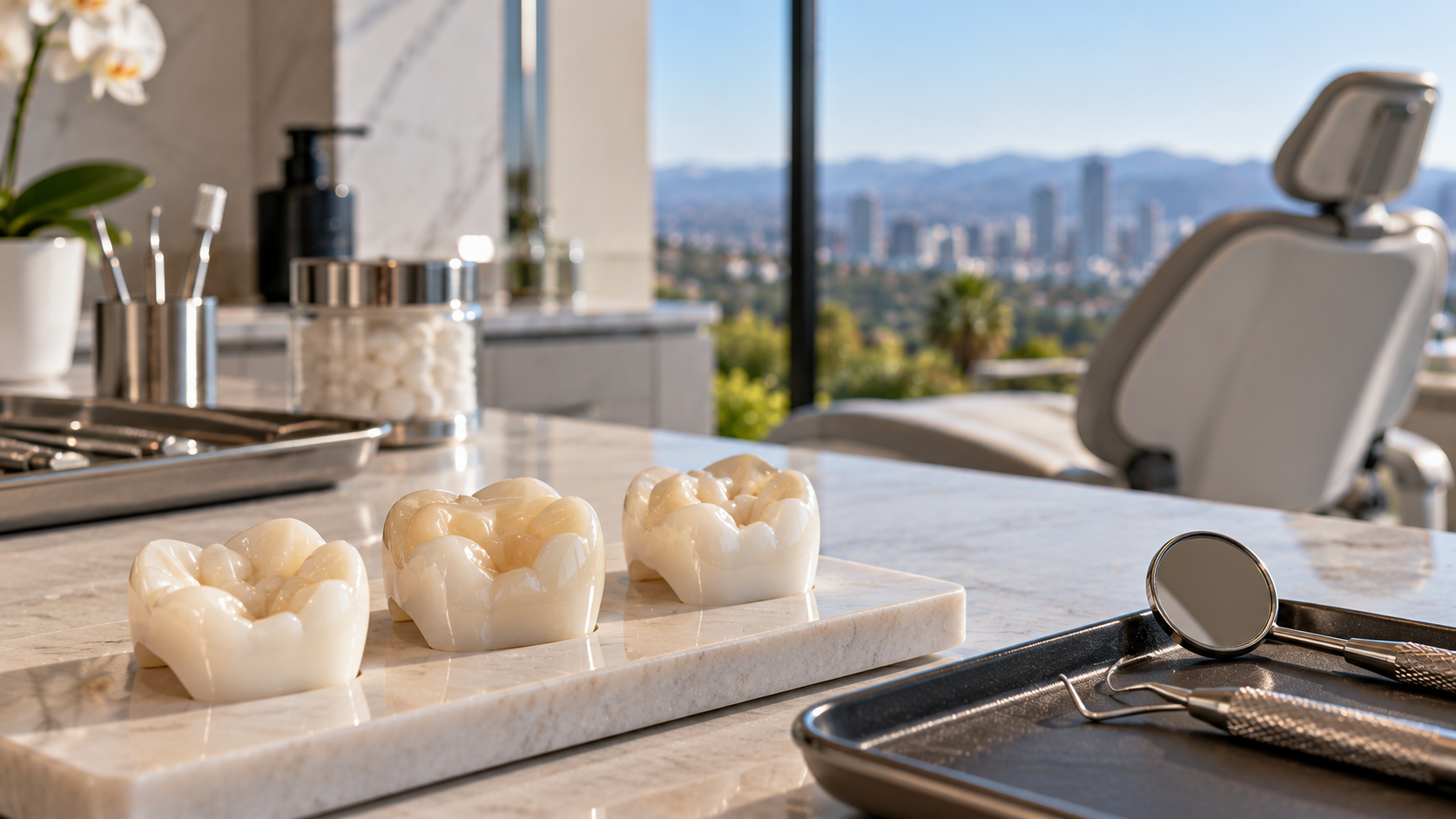
An inlay is a custom-fabricated restoration that fits inside the cusps of a back tooth, like a precise puzzle piece filling a cavity that’s too large for composite resin but doesn’t require capping the whole tooth. An onlay covers the same interior damage and extends over one or more of the cusps themselves. Think of the cusp as the raised peak of a molar. If the damage stays in the valley between peaks, that’s an inlay. If it climbs the peak, that’s an onlay. Both are bonded directly to the remaining tooth structure and can be made from porcelain, ceramic, or gold. The critical distinction: both assume you have healthy tooth structure worth preserving. That’s the entire premise. If that premise isn’t true, neither option is the right call. A crown, by contrast, caps the entire visible tooth. It’s appropriate when the remaining structure is too weak to support a partial restoration without cracking. An implant enters the picture only when the tooth itself is gone or unsalvageable at the root level – and understanding what the main types of dental implants are can help you frame that conversation before you ever sit in the chair.

Why Do So Many Patients End Up Over-Treated or Under-Treated?

The most common mistake isn’t choosing the wrong restoration. It’s choosing a restoration before the full picture is clear. A tooth that looks like it needs an onlay on a standard X-ray sometimes reveals deeper decay once the old filling is removed. A tooth that looks like it needs a crown can sometimes be restored more conservatively once a skilled clinician examines it under magnification. The recommendation changes based on what’s actually there, not what the image suggests. This is why the evaluation matters as much as the treatment. At Implant Dentistry by Doc Rok, every restoration decision starts with a thorough assessment of what’s structurally present, not just what’s visibly damaged. Patients who’ve been told they need a crown sometimes discover an onlay is sufficient. Patients who’ve been told an onlay will work sometimes find the damage is deeper than the initial exam showed. Neither outcome is unusual. It’s the nature of working inside a tooth.

The Restoration Decision Framework: A Practical Guide to Choosing the Right Option

The Structural Threshold Framework is a decision tool built around one question: how much of the original tooth structure is intact and healthy? Use it this way: More than 70% of tooth structure intact, damage contained to the biting surface: An inlay is likely appropriate. The tooth has enough healthy walls to hold a bonded restoration without risk of fracture under chewing pressure. 50-70% intact, damage reaching one or more cusps: An onlay is the candidate. The cusps need coverage to prevent cracking, but the root and walls are still sound enough to anchor the restoration without a full crown. Less than 50% intact, or significant cracks extending toward the gumline: A crown is the more protective choice. Trying to preserve tooth structure at this threshold often means the restoration fails within a few years, which costs more in the long run. Root compromised, infection present, or tooth structurally unsalvageable: The conversation shifts to tooth replacement options. A restoration placed on a failing foundation doesn’t save the tooth. It delays an inevitable extraction while adding cost. Understanding what happens if you don’t remove an infected tooth helps illustrate exactly why that delay carries real consequences. This framework doesn’t replace a clinical exam. It gives you the vocabulary to have an informed conversation with your dentist about what they’re seeing and why they’re recommending what they are.

Is an Inlay or Onlay Actually Better Than a Crown?

Here’s the contrarian position worth stating plainly: more conservative is not always better. The instinct to preserve tooth structure is sound. But an onlay placed on a tooth that needs a crown is a restoration that will fail. When it does, the resulting damage to the remaining structure often means the patient ends up needing an extraction anyway, having spent money on a restoration that bought them two or three years instead of a decade. The goal isn’t to use the least invasive option. The goal is to use the right option for what’s actually there. That said, dentistry has a documented history of over-recommending crowns. A crown removes significantly more healthy tooth structure than an inlay or onlay. Once that structure is gone, every future restoration on that tooth requires a crown. The patient is locked into a more invasive treatment path permanently. Choosing the wrong restoration in either direction has lasting consequences. That’s why a second opinion on complex dental decisions is one of the highest-value steps a patient can take before committing to any significant restoration. If you’re weighing your options and want a clear read on what your tooth actually needs, scheduling a consultation at Implant Dentistry by Doc Rok is a straightforward next step. Dr. Roknian has placed over 10,000 implants and evaluates complex cases regularly, which means she’s seen the full range of what these decisions look like in practice.

How Do Inlays and Onlays Compare to the Alternatives?

 
Situation Best Option Why
Small-to-mid decay, cusps intact Inlay Preserves max structure, bonds well, durable
Decay or fracture reaching cusps Onlay Protects cusps without full crown prep
Less than 50% structure remaining Crown Onlay won’t hold; crown prevents further fracture
Tooth cracked to the gumline Extraction + implant evaluation No restoration survives a subgingival fracture
Root canal completed, structure weakened Crown Post-RCT teeth are brittle; need full coverage
Tooth missing entirely Dental implant Only option that preserves jawbone and function
The table above reflects clinical thresholds, not preferences. Patients sometimes arrive hoping an inlay or onlay will work because they’ve heard those options are “less invasive.” The question isn’t invasiveness. It’s whether the restoration will hold.

What Inlays and Onlays Can’t Do

Inlays and onlays are excellent restorations for the right tooth. They’re not appropriate for every situation, and being clear about that is more useful than overselling them. They don’t work when the tooth has an active infection. Placing any permanent restoration over infected tissue seals the infection in, which accelerates bone loss and can compromise adjacent teeth. The infection has to be resolved first, which sometimes means a root canal, and sometimes means extraction. They don’t address cosmetic concerns on front teeth. Inlays and onlays are back-tooth restorations. If you’re dealing with a chipped or discolored front tooth, cosmetic dentistry in Beverly Hills offers a range of more appropriate options for those situations. They don’t prevent gum disease. A beautifully placed onlay on a tooth surrounded by inflamed, receding gum tissue is a restoration sitting on an unstable foundation. Periodontal health has to be addressed alongside any restorative work. Patients dealing with gum disease alongside structural tooth damage may benefit from understanding how laser periodontal treatment works before committing to a restoration plan. And they don’t replace missing teeth. If the tooth is gone, the only options that preserve bone and restore full function are implant-based. Patients who aren’t sure whether their jawbone can support an implant may also want to explore the signs your jawbone may require support before moving forward. In Beverly Hills, single tooth implants typically range from $4,000 to $8,000 depending on the complexity of the case (Bedford Dental Group, 2024). That’s a real number to plan around.

A Typical Case: When the Right Answer Isn’t Obvious

Consider a patient who comes in with a cracked molar. The crack is visible on the biting surface, there’s an old amalgam filling that’s failed, and the tooth is sensitive to cold. On initial examination, an onlay looks like a reasonable option. But when the old filling is removed, the crack extends further than the X-ray suggested, running down one wall toward the gumline. At that point, an onlay won’t provide adequate protection. The wall it would bond to is compromised. A crown is now the right call, and the patient needs to understand why the recommendation changed. This kind of intraoperative discovery is common. It’s not a bait-and-switch. It’s what happens when you’re working inside a tooth that’s been damaged over years. The honest answer is that no clinician can guarantee the final recommendation until they can see the full picture. The patients who navigate this well are the ones who came in with realistic expectations and a dentist they trust to explain what they’re seeing in real time.

FAQ

How long do inlays and onlays actually last?

With proper care and good oral hygiene, inlays and onlays placed with high-quality materials can last 10 to 30 years. Longevity depends on the material used, the quality of the bond, and whether the underlying tooth remains healthy. Porcelain and ceramic options are more aesthetic; gold is more durable under heavy bite pressure.

Can I get an inlay or onlay if I’ve already had a root canal on that tooth?

A tooth that’s had a root canal is more brittle than a living tooth because it no longer has a blood supply. In most cases, a crown is the more protective choice after a root canal, particularly on a molar that takes significant chewing force. An onlay is sometimes appropriate for smaller restorations on root-canal-treated premolars, but this depends on how much structure remains.

Will insurance cover inlays or onlays?

Coverage varies by plan. Many dental insurance plans treat inlays and onlays as major restorations, covering 50% after a deductible, though some plans classify them differently. It’s worth reviewing your specific plan before treatment. The team at Implant Dentistry by Doc Rok can help clarify what your coverage looks like.

What’s the difference between a porcelain onlay and a gold onlay?

Gold onlays are more durable and require less tooth removal during preparation, but they’re visible on back teeth. Porcelain and ceramic onlays match tooth color and are generally preferred for aesthetic reasons. For patients with heavy bite forces or bruxism, gold may actually be the longer-lasting choice even if it’s less cosmetically appealing.

How do I know if my tooth can be saved or if I need an implant?

The answer comes down to whether the root is intact and infection-free. A tooth with a healthy root can often be restored. A tooth with a vertical root fracture, advanced bone loss from infection, or structural failure below the gumline generally can’t be saved with a restoration. A thorough exam with current imaging is the only way to know for certain.

Is there a point where waiting makes the decision easier?

Waiting almost never makes a damaged tooth easier to treat. Decay progresses. Cracks extend. Bone loss from infection accelerates. A tooth that’s a good candidate for an onlay today can become a crown case in six months and an extraction candidate in a year. The decision doesn’t get simpler with time. It gets more expensive and more limited.

Should I get a second opinion before committing to a crown or implant?

Yes, especially for any restoration that involves removing significant tooth structure or replacing a tooth entirely. A second opinion from a clinician experienced in complex cases, like Dr. Roknian at Implant Dentistry by Doc Rok, can confirm whether the proposed treatment is appropriate or whether a more conservative option is viable. It’s one of the most protective steps you can take. The right restoration is the one that matches what’s actually there, not the one that sounds the least invasive or the most impressive. If you’re not sure which category your tooth falls into, that’s exactly the conversation to have before anyone picks up a drill. Schedule a consultation with Implant Dentistry by Doc Rok in Beverly Hills. Dr. Roknian will give you a direct assessment of what your tooth needs, what the options are, and what happens if you wait. No pressure. Just a clear picture. Contact the practice here.

About the Author

Dr. Vivian Roknian, DMD, is a board-certified implantologist and cosmetic dentist based in Beverly Hills, California. With over 15 years of clinical experience and more than 10,000 implants placed, she specializes in complex dental reconstruction, smile makeovers, and advanced restorative care. Dr. Roknian has trained more than 2,000 dentists nationally and internationally and leads Implant Dentistry by Doc Rok, where personalized care and clinical precision guide every treatment decision.

References

Bedford Dental Group – cost of dental implants in Beverly Hills
Posted in Uncategorized

Dental Implants and GLP-1 Medications: What most dentists won’t tell you

I’ve placed thousands of dental implants over my career. I teach implant surgery to other dentists at the Misch International Implant Institute. And I can tell you with complete certainty: if you’re taking GLP-1 medications and considering implants, you need to be having a much more detailed conversation than most dentists are prepared to have. This isn’t about scaring you away from implants. I place implants in patients on these medications all the time. But success requires understanding the specific challenges these medications create, and planning accordingly. Most dentists don’t want to deal with complicated cases. They want straightforward, textbook implants in patients with perfect health and perfect bone. When something doesn’t fit that mold, they either tell you you’re not a candidate or they place the implant anyway and hope for the best. I built my practice around the cases other dentists won’t touch. Failed implants. Severe bone loss. Complex medical histories. Patients who’ve been told they’re out of options. So when GLP-1 medications started becoming common, I immediately started paying attention to how they affect implant outcomes. Here’s what I’ve learned.

The Three Problems with GLP-1 Medications and Dental Implants

  1. Osseointegration Depends on Nutrition
Dental implants work by fusing with your jawbone. That process is called osseointegration, and it requires adequate protein, calcium, vitamin D, and other nutrients. GLP-1 medications suppress appetite. A lot of my patients on these medications aren’t eating enough protein to support their basic tissue maintenance, let alone the demands of healing bone around a new implant. If you don’t have the nutritional building blocks, the bone won’t integrate properly with the implant. The implant might feel fine initially, but long-term stability is compromised. I’ve seen implants fail years after placement because the patient never had adequate nutrition during the critical healing period.
  1. Dry Mouth Kills Implants Slowly
Saliva protects your natural teeth. It also protects implants. Without adequate saliva, bacteria colonize the areas around implants much faster. That leads to peri-implantitis, which is infection and bone loss around the implant. Peri-implantitis is why implants fail in the long term. Not because the surgery was done wrong. Not because the implant was defective. Because the tissue and bone around it became infected and couldn’t fight it off. GLP-1 medications create severe dry mouth. If you’re not managing that aggressively, your implants are at much higher risk of failure regardless of how well they were placed initially.
  1. Healing Is Compromised
Implant surgery is surgery. Your body needs to heal the surgical site, integrate the implant with bone, and maintain healthy tissue around it. All of that requires good healing capacity. Patients on GLP-1 medications often have compromised healing for multiple reasons: nutritional deficiency, dry mouth affecting tissue health, possible acid damage to surrounding areas, and in some cases the metabolic issues that led them to need these medications in the first place. Does that mean you can’t get implants? No. But it means we need to approach the case differently than we would for someone without those risk factors.

What makes an implant case complex

Not all implants are created equal. A single implant in good bone with healthy gums is straightforward. Multiple implants in compromised bone with active gum disease and multiple medical conditions is complex. GLP-1 medications automatically move you into the “needs more planning” category. Add in any of these factors and you’re in territory where you need someone with significant experience:
  • History of gum disease (active or treated)
  • Significant bone loss
  • Previous failed implants
  • Diabetes or other metabolic conditions
  • Smoking or history of smoking
  • Medications that affect bone density (bisphosphonates, etc.)
  • Grinding or clenching (bruxism)
  • History of poor healing
If you have multiple risk factors, you need a dentist who has handled cases like yours before. Not someone who’s going to learn on you.

Pre-Surgical Optimization Matters

Before I place implants in a patient on GLP-1 medications, we do a comprehensive work-up. Blood work to check nutritional status. Review of their actual dietary intake. Assessment of their dry mouth severity. Evaluation of any acid damage that might affect the surgical site. If there are deficiencies, we address them first. I’m not going to place a $5,000 implant in someone whose body isn’t capable of healing it properly. That’s setting everyone up for failure. For some patients, that means delaying surgery for 2-3 months while we get their nutrition optimized. For others, it means working with their physician to adjust their medication timing around the surgery. For some, it means implementing aggressive dry mouth management protocols before we even schedule the procedure. This is what I mean when I say I take a whole body approach. I’m not just looking at whether there’s enough bone to put an implant in. I’m looking at whether your body can actually support that implant long-term.

Surgical Modification for High Risk Patients

The actual surgical technique also changes for patients with compromised healing. I use laser protocols during implant placement to:
  • Decontaminate the surgical site more thoroughly
  • Stimulate better blood flow and healing
  • Reduce bacterial load before placing the implant
  • Create a cleaner environment for integration
I’m also more conservative with immediate loading (putting a crown on the implant right away). With a compromised healing capacity, sometimes it’s worth taking the slower approach to ensure proper integration. And I’m very particular about the type of implant, the surface treatment, and how it’s placed. Small technical decisions during surgery can make a big difference in long-term outcomes, especially for higher-risk patients.

Post-Op Care is where most cases succeed or fail

The surgery is only part of the process. What happens after determines whether the implant succeeds long-term. For patients on GLP-1 medications, post-operative care is critical:
  • More frequent monitoring during the integration period
  • Aggressive management of dry mouth throughout healing
  • Strict maintenance schedule after the implant is restored
  • Early intervention at the first sign of any problem
I see patients every 3-4 months instead of every 6 months. We’re watching for any early signs of peri-implantitis and treating it immediately if we see it. Waiting until it’s a major problem means we’ve already lost significant bone. I also use laser protocols for maintenance. The PerioLase can keep implants healthy by controlling bacteria and inflammation before it becomes a serious issue. This is preventive care, not reactive care.

Failed Implants and Rescue Cases

A lot of patients come to me after they’ve already had an implant fail somewhere else. Usually they’ve been told they can’t have another implant, or they need extensive bone grafting, or they should just get a bridge or partial denture. Sometimes that’s true. Sometimes the bone loss is too extensive, or the medical conditions are too severe, or the patient isn’t willing to do what’s necessary to make it work. But often, there are options. I’ve successfully placed implants in sites where previous implants failed by addressing what caused the failure in the first place. If it failed because of infection, we treat the infection aggressively before placing a new implant. If it failed because of inadequate bone, we do proper bone grafting. If it failed because the patient had undiagnosed grinding, we address that with a nightguard. For GLP-1 patients specifically, failed implants are often related to peri-implantitis that wasn’t caught and treated early enough. The dry mouth created an environment where bacteria thrived. The patient wasn’t coming in frequently enough for monitoring. By the time there was pain or obvious problems, significant bone was already lost. Can we save these cases? Sometimes. It depends on how much bone is left, whether the infection is fully cleared, and whether we can create a better environment for a new implant than existed for the first one. I don’t promise miracles. But I also don’t give up on cases just because they’re difficult.

All-On-X Implants for GLP-1 Patients

Full-arch implant cases (often called All-on-4 or All-on-X) are already complex. Add in GLP-1 medications and you’re in territory where you really need someone experienced. These cases require excellent bone quality, meticulous surgical technique, proper prosthetic design, and rigorous maintenance. If any part of that chain breaks down, the entire case can fail. I do full-arch cases, but I’m selective about who I accept. If you’re on GLP-1 medications and considering this, we need to have a very honest conversation about:
  • Your nutritional status and whether it can support this much surgery
  • Your ability to maintain excellent oral hygiene around the prosthetic
  • Your commitment to coming in for regular maintenance
  • Whether your expectations are realistic
  • Whether there are better options for your situation
Full-arch implants are expensive and time-intensive. They’re also life-changing when done correctly in the right patient. But they’re not the right choice for everyone, and I’m not going to sell you on it if I don’t think it’s your best option.

What you need from your implant dentist

If you’re taking GLP-1 medications and you need implants, here’s what you should expect from your dentist:
  1. Comprehensive medical and nutritional assessment before planning surgery
  2. Clear discussion of risks specific to your medication and medical history
  3. Modified treatment plan that accounts for your compromised healing capacity
  4. More frequent monitoring than standard implant patients require
  5. Aggressive preventive care to protect your investment long-term
  6. Willingness to coordinate with your physician about medication management around surgery
If your dentist isn’t asking detailed questions about your overall health, your diet, your other medications, and your ability to maintain oral hygiene, they’re not taking your case seriously enough. And if they’re promising you that implants will be no problem despite your risk factors, they either don’t understand the risks or they’re not being honest with you.

The Bottom Line

Dental implants can absolutely be successful in patients taking GLP-1 medications. I place them all the time. But success requires careful planning, surgical expertise, and long-term commitment to maintenance. This is not a “get the implant and forget about it” situation. Your mouth is in a compromised state. Your implants need more attention than someone without your risk factors would need. If you’re willing to do what’s necessary, work with someone experienced, and stay committed to the maintenance schedule, implants can change your life. But you need to go into it with realistic expectations about what’s required. I specialize in complex implant cases because I find them interesting and because I’m good at solving problems that don’t have obvious solutions. GLP-1 patients fall into that category. You’re not impossible to treat. You just need someone who understands what makes your case different and knows how to adjust accordingly.
Posted in Uncategorized

What Peptide Research Means for the Future of Dental Regeneration (And Why I’m Not Using It Yet)

I spend a lot of time reading research that has nothing to do with what I’m doing today in my practice. That might sound like a waste of time. It’s not. Understanding where science is headed helps me make better decisions about the technologies I use now—and helps me spot the difference between genuine innovation and expensive hype. Today I want to talk about peptide research in oral regeneration. Not because I’m using peptide treatments (I’m not), but because understanding this science explains why some of our current approaches work, and where dentistry might be headed in the next decade.

Let Me Be Clear Up Front

I am not offering peptide therapies. I’m not experimenting with unproven treatments. What I’m about to discuss is emerging research—some of it promising, much of it still theoretical, all of it years away from mainstream clinical use. The goal isn’t to be first. The goal is to be right. But I do think dentists who want to stay ahead need to understand this research, because it’s going to reshape how we think about tissue regeneration, wound healing, and even how we approach existing treatments like laser therapy.

What Are Peptides, and Why Should Dentists Care?

Peptides are short chains of amino acids—basically, small pieces of proteins. Your body produces thousands of them, and they act as signaling molecules that tell cells what to do. Think of them as text messages between cells. Some peptides tell cells to grow. Some tell them to fight infection. Some trigger inflammation. Some shut it down. What makes peptides interesting for dentistry is that they’re highly specific. Unlike broad-spectrum drugs that affect multiple systems, peptides can target very specific cellular responses. In theory, you could use peptides to:
  • Accelerate tissue regeneration after surgery
  • Reduce inflammation more precisely than NSAIDs
  • Stimulate bone growth around implants
  • Enhance natural antimicrobial defenses in the mouth
  • Speed wound healing in compromised patients
That’s the promise. Here’s the reality.

The Current State of Peptide Research in Dentistry

Most peptide applications in dentistry are still in the “interesting laboratory results” phase. There’s legitimate science happening, but we’re far from having FDA-approved peptide therapies you can use in clinical practice. Some areas showing promise: BPC-157 (Body Protection Compound): This synthetic peptide shows potential for accelerating wound healing and reducing inflammation. There’s animal research suggesting it might speed recovery from oral surgery. But we don’t have large-scale human trials showing it’s safe and effective for dental use. Thymosin Beta-4: Another peptide with potential for tissue repair and regeneration. Some research suggests it could help with gingival healing and might even support bone regeneration. Again—early research, not clinical standard of care. GHK-Cu (Copper Peptide): Studies suggest this might support tissue remodeling and have antimicrobial properties. It’s being explored for periodontal applications. Still experimental. Could these eventually become useful clinical tools? Maybe. But right now, they’re research topics, not treatment options.

Where This Gets Really Interesting: LL-37

Here’s where peptide science connects to something I’m already seeing in practice—and it ties directly back to the GLP-1 medication discussion I’ve been writing about. LL-37 is a natural antimicrobial peptide produced in your body. It’s found in saliva, and it’s part of your mouth’s first-line defense against bacteria. When GLP-1 medications reduce saliva production, they’re not just causing dry mouth—they’re reducing LL-37 levels. You’re losing a critical part of your natural antimicrobial defense system. This explains, at a molecular level, why patients on GLP-1 medications are at higher risk for:
  • Increased caries (cavities)
  • Periodontal disease progression
  • Slower healing after dental procedures
  • Higher infection risk
It’s not just that dry mouth is uncomfortable. It’s that the entire peptide-based defense system in the oral cavity is compromised. Understanding this mechanism changes how I approach treatment for these patients. It’s why I’m more aggressive with preventive care, more careful with post-operative protocols, and why I spend extra time on patient education about their elevated risk. This is a perfect example of why reading research matters—even when you’re not using the experimental treatments being studied. Understanding the biology helps you make better decisions with the tools you already have.

Why Laser Therapy Works (A Peptide Perspective)

Here’s another connection that’s worth understanding: my laser work likely succeeds in part because of peptide signaling. When I use lasers for tissue management, wound healing, or bone regeneration around implants, part of what’s happening is that the laser energy is triggering cellular responses—including the release of growth factors and signaling peptides. I’m not injecting peptides. I’m not applying peptide gels. But I’m using energy-based technology that stimulates the body’s own peptide production and signaling pathways. This is why laser therapy accelerates healing, reduces inflammation, and supports tissue regeneration. It’s working with the body’s natural peptide-based repair mechanisms. Understanding this helps me optimize treatment protocols. It explains why certain laser wavelengths and power settings produce better results than others. It’s the difference between knowing “this works” and understanding “this is why it works.”

The Critical Questions I Ask About Any New Technology

Whether it’s peptides, AI, new implant surfaces, or anything else that promises to revolutionize dentistry, I evaluate new technologies with the same framework:
  1. What’s the evidence quality? Animal studies? Small human trials? Large randomized controlled trials? FDA approval? Peer-reviewed publications or company white papers?
  2. What’s the mechanism of action? Do we understand why this works, or are we just seeing an effect? Understanding mechanism helps predict when something will work and when it won’t.
  3. What’s the safety profile? Short-term effects versus long-term unknowns. Risk-benefit ratio. Potential for unintended consequences.
  4. What’s the regulatory status? Is this FDA-approved for the indication we’re discussing? Off-label use? Completely experimental? This matters for liability and patient safety.
  5. What problem does this solve that existing solutions don’t? Is this genuinely better, or just different? New isn’t always improved.
Right now, when I apply these questions to peptide therapies in dentistry, the answers are: promising research, some understanding of mechanism, unclear long-term safety, not FDA-approved for most applications, and no clear advantage over existing proven treatments. That doesn’t mean peptides are bad. It means they’re not ready for routine clinical use.

What I’m Watching For

I’m tracking several areas of peptide research that could eventually change clinical practice: Bone regeneration peptides that might accelerate healing around implants, especially in compromised patients (diabetics, smokers, patients on bisphosphonates). Antimicrobial peptides that could provide targeted infection control without antibiotic resistance concerns—particularly relevant for implant maintenance. Wound healing peptides that might reduce recovery time after surgery and reduce complications in high-risk patients. Peptide-based diagnostic tools that could detect early disease before traditional methods (this is where AI and peptide research intersect—using AI to analyze peptide signatures in saliva as early disease markers). That last one is especially interesting to me. If we can use AI to analyze peptide patterns in saliva and detect periodontal disease or oral cancer earlier than visual examination, that changes everything about prevention and early intervention. But we’re not there yet. We’re in the “watching the research, understanding the science, waiting for clinical validation” phase.

Why I’m Not Using Experimental Peptide Treatments

Some dentists are already offering peptide therapies—typically through compounding pharmacies or as “wellness” add-ons to treatment. I’m not one of them. Here’s why: Insufficient evidence. I need to see large-scale human trials showing safety and efficacy. A few case reports and promising lab results aren’t enough for me to recommend this to patients. Unclear regulatory status. Many peptide products exist in a gray area—not FDA-approved for dental use, but available through compounding. I’m not comfortable with that level of uncertainty. Liability concerns. If something goes wrong with an experimental treatment, where does that leave me and the patient? Existing solutions work. Between laser therapy, proven surgical techniques, and proper post-operative care, I can achieve excellent outcomes without adding experimental peptides. Could my position change as research evolves? Absolutely. But I’m not going to experiment on patients to be on the “cutting edge.” The patients who come to me for complex implant cases, extensive bone grafting, or challenging periodontal work deserve treatments with robust safety profiles and proven track records—not treatments I’m curious about.

How This Connects to AI and Innovation

Here’s what reading peptide research has taught me about evaluating innovation in dentistry: The best innovations aren’t the flashiest ones. They’re the ones that understand biology deeply and work with the body’s natural processes rather than trying to override them. AI applications in dentistry will succeed when they enhance clinical judgment, not replace it. Same with peptides—they’ll succeed when they support natural healing processes we already understand, not when they promise miracle results that bypass biological reality. This is why I’m interested in AI for diagnostic analysis (finding patterns humans miss) and peptide research that triggers natural regeneration (working with biology, not against it). Both require the same critical thinking: What’s the mechanism? What’s the evidence? How does this improve on what we’re already doing?

The Bottom Line for Patients

If you’re my patient, you should know: I read research constantly. I track emerging technologies. I understand the science behind new treatments at a molecular level. And then I make conservative, evidence-based decisions about what I actually use in your mouth. That might seem contradictory—why spend time learning about treatments you won’t use? Because understanding where the science is headed makes me better at using the tools available today. Because knowing what’s experimental helps me avoid chasing hype. Because distinguishing real innovation from marketing helps me invest in equipment and training that will actually improve outcomes. You deserve a dentist who thinks critically about evidence, understands the biology behind treatments, and makes strategic decisions about when to adopt new technology. That’s what I’m doing with peptide research. Learning from it. Watching it evolve. Using what I learn to inform better treatment decisions with proven tools. And when peptide therapies do become proven, FDA-approved, evidence-based options? I’ll be ready to evaluate them with the same rigorous standards I apply to everything else.

The GLP-1 Blind Spot: Why Dentistry Needs to Catch Up Fast

Twelve million Americans are taking GLP-1 medications. That number is growing exponentially. And most dental practices have no protocol for managing the oral health complications these medications create. This is a massive gap, and it’s going to bite us if we don’t address it.

The Problem We Are Not Discussing

I’ve been working with medically complex patients for years. Bariatric surgery patients. Cancer patients undergoing treatment. People managing multiple metabolic conditions. When GLP-1 medications started becoming mainstream, I immediately recognized the pattern. These medications create:
  • Severe xerostomia (reduced saliva production)
  • Increased GERD and acid exposure
  • Nutritional compromise affecting healing capacity
  • Altered taste perception influencing dietary choices
Sound familiar? It should. It’s almost identical to the oral health challenges we see post-bariatric surgery. But here’s the difference: bariatric patients are a relatively small population, and most practices have developed some level of awareness about their needs. GLP-1 patients are becoming mainstream. This isn’t a niche issue anymore.

What’s Falling into Practice

Most practices are handling GLP-1 patients the same way they handle everyone else. Six-month recalls. Standard fluoride protocols. Generic oral hygiene instructions. That’s not enough. Not even close. These patients need:
  • Shortened recall intervals (3-4 months minimum)
  • Aggressive dry mouth management beyond “drink more water”
  • Modified home care protocols that account for compromised natural defenses
  • Careful monitoring for early signs of caries and periodontal disease
  • Pre-surgical optimization if they’re considering implants
  • Enhanced education about acid management after reflux or vomiting
And critically, they need us to actually ask about these medications during medical history review. A lot of patients don’t mention them because they don’t think it’s relevant to their teeth.

The Implant Competition

This gets worse when you’re placing implants. Osseointegration requires adequate nutrition. Long-term implant success requires healthy saliva production and good tissue maintenance. GLP-1 medications compromise both. I’m not saying don’t place implants in these patients. I’m saying you need to:
  • Do comprehensive nutritional assessment before surgery
  • Modify your surgical protocols to account for compromised healing
  • Plan for more intensive post-operative monitoring
  • Implement rigorous maintenance schedules
  • Use every tool you have (including laser protocols if you have them) to prevent peri-implantitis
The patients who develop peri-implantitis in their 40s and 50s? Increasingly, GLP-1 medications are part of the picture. The dry mouth creates an environment where bacteria thrive around implants. By the time they have symptoms, you’ve often lost significant bone.

The Sedation Safety Issue

Here’s something most dentists aren’t aware of: GLP-1 medications significantly delay gastric emptying, which increases aspiration risk during sedation. This isn’t theoretical. This is a documented anesthesia concern that your medical colleagues are very aware of. Extended fasting protocols. Medication holds. Modified sedation approaches. If you’re doing sedation dentistry and you’re not specifically asking about GLP-1 medications and adjusting your protocols accordingly, you have a liability problem.

Why this matters for your practice

Beyond the clinical concerns, this is a strategic opportunity. The practices that develop real expertise in managing GLP-1 patients are going to attract a significant patient population that most dentists are underprepared to handle. This is similar to what happened with Invisalign. Early adopters who actually learned the system well built substantial practices around it. Dentists who bought the scanner but never really invested in understanding the biomechanics struggled. GLP-1 oral health management is headed the same direction. You can be the practice that handles these patients well, or you can be the practice that watches complications develop and doesn’t understand why.

What the Profession Needs

We need continuing education that actually addresses this. Not as a footnote in a medical history update, but as a specific focus area. What are the actual complications? What protocols work? What’s the evidence base? We need better integration between medicine and dentistry. When physicians prescribe these medications, they should be telling patients to see their dentist more frequently and be alert for oral health changes. That’s not happening systematically. We need to stop treating medical complexity as someone else’s problem. Your operatory isn’t a bubble separate from the rest of the patient’s health. Their medications affect your outcomes. Their nutrition affects your surgical success. Their medical conditions determine whether your treatment plan is even viable.

Where I see this Going

In five years, managing GLP-1 implications will be standard dental education. Practices will have specific protocols. Insurance companies will recognize the need for more frequent monitoring in these patients. But right now, we’re in the early phase where most dentists are behind the curve. The patients are already in your chairs. The medications are already affecting their oral health. Whether you’re prepared to handle it or not, it’s happening. I teach implant surgery to dentists around the country. This is increasingly part of the conversation. Not as a theoretical future issue, but as something we’re seeing in practices right now. Failed implants in GLP-1 patients who never had adequate monitoring. Aggressive periodontal disease progression in patients whose dry mouth was never properly managed. Surgical complications in patients whose nutritional status was never assessed. These are preventable problems. But prevention requires awareness, protocols, and commitment to managing these patients differently than the standard approach.
Posted in Uncategorized

GLP-1 Medications and Your Oral Health: What You Actually Need to Know

If you’re taking Ozempic, Wegovy, Mounjaro, or any of the other GLP-1 medications, I need to talk to you about your mouth. Not because I want to scare you, but because I’ve been seeing a pattern in my practice that’s becoming impossible to ignore. These medications are genuinely life-changing for a lot of people. I get that. But they create specific problems in your mouth that most doctors aren’t talking about, and most patients don’t find out about until there’s already damage. I’ve spent my career taking care of patients going through major metabolic changes. I work with a lot of bariatric surgery patients and people managing complex medical conditions during cancer treatment. So when GLP-1 medications started becoming mainstream, I immediately recognized the oral health risks. They’re almost identical to what I see with my bariatric patients, just from a different mechanism. Here’s what’s actually happening, and what you need to do about it.

The Four Problems We Are Seeing: 

  1. Your Mouth Gets Incredibly Dry
This is the big one. GLP-1 medications reduce saliva production significantly. And saliva isn’t just moisture – it’s your mouth’s entire defense system. It neutralizes acids, helps remineralize early decay, washes away bacteria, and contains antimicrobial proteins that actively fight infection. When you don’t have enough saliva, everything falls apart. Cavities develop faster. Gum disease progresses more aggressively. Early decay that your mouth would normally reverse on its own just keeps getting worse. I’ve seen patients who’ve gone their whole lives without a cavity suddenly develop multiple in a year after starting these medications.
  1. Acid Reflux Destroys Your Enamel
GLP-1 medications slow down how fast your stomach empties. That’s part of how they work for weight loss – you feel full longer. But it also means stomach acid has more opportunity to come back up. And when stomach acid hits your teeth repeatedly, it dissolves enamel. Not damages it. Dissolves it. That damage is permanent. I see this erosion pattern constantly now. It’s different from regular cavities – the enamel just thins out and wears away, especially on the inner surfaces of your teeth. Once it’s gone, it’s gone. We can’t grow it back. And if you’re one of the people dealing with nausea and vomiting from these medications? That acid exposure is even worse.
  1. Your Nutrition Takes a Hit
These medications suppress appetite. That’s the point. But a lot of patients aren’t eating enough protein, calcium, vitamin D, or other nutrients that are critical for keeping your mouth healthy. This is especially problematic if you’re considering dental implants or already have them. Implants need good bone health to integrate properly and stay stable long-term. I ask every patient about their family history and diet because I want to make sure you’re not setting yourself up for the same problems your parents had. If your mom lost her teeth at 50, we need to talk about why and whether you’re headed in the same direction.
  1. Everything Tastes Different
Taste changes are common with GLP-1 medications. And when food doesn’t taste right, people compensate by eating more intensely flavored things – which often means more sugar, more acid, or both. It’s not a huge problem on its own, but combined with everything else, it adds up.

The Sedation Risk No One Talks about

This is critical. If you’re taking GLP-1 medications and you need any dental procedure with sedation, you need to tell your dentist. Not as a casual mention – as the first thing you say when discussing the procedure. These medications significantly delay stomach emptying, which means you have a much higher risk of aspirating during sedation. Aspiration is when stomach contents get into your lungs. It’s serious. It can be life-threatening. We modify our protocols when we know you’re on these medications. Extended fasting times. Coordination with your prescribing physician. Different sedation approaches. But we can only do that if you tell us.

What Actually Works to Protect Your teeth

I’m not going to give you a generic list that looks like it came from a dental hygiene pamphlet. Here’s what actually works based on what I’ve seen with my patients: For Dry Mouth: Drink water constantly. Not just “stay hydrated” – I mean keep water with you all day and sip it continuously. Your mouth needs that mechanical washing action. Use alcohol-free rinses with xylitol or fluoride. The alcohol in regular mouthwash makes dry mouth worse. Chew sugar-free gum with xylitol. It stimulates saliva production. Do this after meals especially. Products like Biotene help, but they’re temporary relief. You’re managing a chronic problem, not fixing it. For Acid Damage: This is where most people make a critical mistake. If you vomit or have acid reflux, DO NOT brush your teeth right after. The acid softens your enamel, and brushing at that moment causes significantly more damage than the acid alone. Instead: rinse with water or a baking soda solution (one teaspoon in eight ounces of water). Wait 30 to 60 minutes. Then brush. Use high-fluoride toothpaste. Ask your dentist about prescription-strength options. Regular fluoride isn’t enough when you’re dealing with this much acid exposure. If you have reflux, work with your doctor to get it under control. Protecting your teeth starts with managing the acid at its source. For Nutrition: Even though your appetite is suppressed, you need to prioritize certain things:
  • Protein: minimum 0.8 to 1.0 grams per kilogram of body weight. Your gums are tissue. Tissue needs protein.
  • Calcium: 1000 to 1200mg daily for bone and tooth structure
  • Vitamin D: 2000 to 4000 IU daily (or whatever your doctor recommends) for calcium absorption
  • Vitamin C: critical for gum health and collagen synthesis
  • B vitamins: support tissue health and healing
Talk to your doctor about supplementation if you’re not getting these from food. Professional Care: Come in more often. If you’re on GLP-1 medications, you should be getting your teeth cleaned every three to four months instead of every six months. This isn’t upselling – it’s risk management. We need to catch problems early, before they become expensive and painful.

If You have Implants or Want Implants

I’ve placed thousands of dental implants and trained over 2,000 dentists in implant surgery at the Misch International Implant Institute. So I pay very close attention to anything that affects how implants heal and how long they last. If you’re taking GLP-1 medications and considering implants, we need to have a more detailed conversation about timing, nutrition optimization, and monitoring. Implants rely on good bone health and good healing. These medications can compromise both if we’re not proactive. If you already have implants, the dry mouth and potential nutritional issues put you at higher risk for peri-implantitis – which is basically gum disease around the implant. Left untreated, it leads to implant failure. We can treat it with laser protocols (I use the PerioLase for this), but catching it early makes a massive difference.

When You Need to Call

Don’t wait until something hurts. Call if you notice:
  • Persistent sensitivity to hot, cold, or sweets
  • Bleeding gums
  • White spots on your teeth (that’s early decay)
  • Teeth that look more translucent or yellow than they used to
  • Any sore or lesion in your mouth that doesn’t heal in two weeks
  • Chronic dry mouth that isn’t improving with the basics

What this really comes down to

GLP-1 medications work. I’m not telling you to stop taking them. But you need to understand that they create a high-risk environment in your mouth, and that risk doesn’t go away on its own. The patients who do well are the ones who are proactive. They adjust their home care. They come in more often. They actually follow through with the fluoride treatments and the dietary recommendations. They tell me when something changes. The patients who struggle are the ones who think they can keep doing what they’ve always done and everything will be fine. It won’t. These medications change the game, and your dental care needs to change with them. I built my practice around taking care of people going through complicated health situations. Whether it’s bariatric surgery, cancer treatment, or complex dental failures that other dentists won’t touch – I specialize in cases where the standard approach doesn’t work anymore. GLP-1 medications fall into that category. You need someone who understands what’s happening systemically and knows how to adjust their care accordingly. If you’re taking these medications and you’re not sure your current dentist is paying attention to these risks, that’s a problem. This isn’t something you can afford to ignore until there’s a crisis.
Posted in Uncategorized

Why Laser Protocols Matter More For GLP-1 Patients

I’ve been working with lasers in dentistry for years, and I’m going to be direct with you: most dentists who have a laser don’t actually know how to use it to its full potential. They use it for minor gum contouring or to remove a small lesion and think that’s laser dentistry. It’s not. Real laser protocols, done correctly, can completely change outcomes for patients dealing with gum disease and implant problems. And if you’re taking GLP-1 medications like Ozempic or Wegovy, laser treatment isn’t just a nice option. It might be the only thing standing between you and significant tooth loss. Here’s why.

The Problem with Traditional Gum Surgery

Traditional periodontal surgery involves cutting away diseased gum tissue with a scalpel, then stitching everything back together. It works, but it’s traumatic. You have weeks of healing, significant discomfort, and you’ve permanently lost that tissue. For most patients, that’s already less than ideal. For patients on GLP-1 medications, it’s actively problematic. Remember what these medications do: they create severe dry mouth, which means you’ve lost most of your mouth’s natural defense mechanisms. They often cause acid reflux, which is constantly bathing your mouth in bacteria-feeding acid. And they can compromise your nutritional status, which affects how well you heal. So you’re taking someone whose mouth is already in a high-risk state, creating a large surgical wound, and expecting them to heal well. That’s not a great setup.

What Laser Protocols do differently? 

The laser I use is the PerioLase MVP-7. It’s not just “a laser.” It’s the only FDA-cleared laser for true periodontal regeneration. That distinction matters, and here’s why:
  1. It targets bacteria without destroying healthy tissue
The wavelength selectively targets diseased tissue and bacteria while leaving healthy tissue alone. We’re not cutting away everything – we’re precisely removing what needs to go and preserving what doesn’t.
  1. It stimulates actual regeneration
This isn’t just about removing disease. The laser stimulates your body to regenerate bone and attachment that was lost to gum disease. Traditional surgery can’t do that. You’re removing disease but you’re not getting that structure back.
  1. It disinfects in real time
As I’m working, the laser is simultaneously killing bacteria at the site. For a patient with compromised saliva production who can’t fight bacteria naturally anymore, this is huge.
  1. Healing is significantly faster and less painful
No cutting. No stitches. Minimal trauma to the tissue. Most of my LANAP patients are back to normal activities within a day or two. Compare that to traditional surgery where you’re dealing with swelling and discomfort for weeks.

The LANAP Protocol for Gum Disease

LANAP stands for Laser Assisted New Attachment Procedure. It’s a specific protocol developed for treating periodontal disease with the PerioLase laser. I can treat the entire mouth in about 90 minutes. No scalpels. No stitches. The laser goes between the tooth and the gum, removes the diseased tissue and bacteria, then stimulates a blood clot that allows new attachment to form. Patients typically have about eight follow-up appointments that are 15 minutes each. That’s it. Total chair time is a fraction of what traditional surgery requires, and the outcomes are consistently better. For GLP-1 patients specifically, here’s what matters:
  • Minimal trauma means less risk of infection in an already compromised environment
  • Faster healing means less time vulnerable to the dry mouth and acid exposure issues
  • No exposed wound means bacteria can’t colonize a surgical site the way they do with traditional surgery
  • Stimulated regeneration gives us the best possible long-term outcome
The #1 question I get about LANAP is “Does it really work?” Yes. The clinical data is solid. But like any treatment, outcomes depend on patient compliance with home care and maintenance. I can remove the disease and stimulate regeneration, but you have to keep your mouth clean and come in for your maintenance appointments.

LAPIP For Dental Implants

If you have dental implants and develop peri-implantitis (basically gum disease around the implant), the traditional approach has been pretty limited. Clean it out as best you can, maybe do some bone grafting, and hope for the best. Success rates aren’t great. LAPIP is the Laser Assisted Peri-Implantitis Procedure. Same laser, different protocol. It’s specifically designed to treat infection around implants without removing the implant. This is critical for GLP-1 patients because dry mouth significantly increases your risk of peri-implantitis. Without adequate saliva, bacteria build up faster around the implant. If you’re not catching it early and treating it properly, you lose the implant. LAPIP lets me decontaminate the implant surface, remove diseased tissue, and stimulate healing around the implant – all without cutting or removing it. The procedure takes about 30 minutes per implant. Patients typically have minimal discomfort and can function normally right away. I’ve saved implants that other dentists said needed to come out. The key is catching it before the bone loss is too extensive and using the right protocol to actually address the infection, not just temporarily clean it up.

Why Dentists Don’t Do This

Laser dentistry requires significant investment in equipment and training. The PerioLase costs about the same as a luxury car. The training to use it correctly for LANAP and LAPIP takes time and ongoing education. A lot of dentists buy a cheaper laser, use it for minor procedures, and call themselves a “laser practice.” But there’s a massive difference between having a laser and actually being able to deliver advanced laser protocols that change patient outcomes. I started working with lasers because I wanted better options for my patients who were medically complicated or dealing with failed traditional treatments. The more I used them, the more I realized this should be the standard approach, not the alternative. When I teach other dentists about implant surgery and advanced procedures, laser protocols are always part of the conversation. This isn’t boutique or experimental. It’s simply better dentistry when done correctly. You should be thinking about LANAP if you have:
  • Moderate to severe gum disease
  • Bleeding gums that haven’t responded to regular cleanings
  • Deep pockets around your teeth
  • Bone loss visible on x-rays
  • Medical conditions that make traditional surgery risky (this includes being on GLP-1 medications)
  • A history of poor healing
  • Fear of traditional gum surgery
You should be thinking about LAPIP if you have:
  • Implants with bleeding or inflammation around them
  • Bone loss around an existing implant
  • An implant that feels loose or painful
  • A history of implant problems
  • Risk factors for peri-implantitis (smoking, diabetes, dry mouth, history of gum disease)

What about Cost

LANAP and LAPIP cost more than traditional treatments up front. The technology is expensive, the training is extensive, and the clinical time is significant. But here’s what you need to consider: what’s the cost of losing teeth or losing an implant? What’s the cost of multiple failed traditional surgeries before you finally find something that works? What’s the cost of not being able to eat properly or smile confidently? Most of my patients who go through with laser treatment tell me they wish they’d done it years earlier. Not because it’s pain-free (though that’s nice), but because it actually solves the problem instead of just managing it temporarily.

The Bottom Line for GLP-1 Patients 

If you’re taking these medications and you’re starting to see signs of gum disease, don’t wait. Traditional “watch and wait” doesn’t work anymore. Your mouth is in a compromised state and problems will progress faster than they would otherwise. Laser protocols give us the ability to treat aggressively without being traumatic. We can address the disease, preserve as much of your natural structure as possible, and set you up for long-term success – all while working with your body’s compromised healing capacity rather than against it. I’m not saying laser treatment is the only answer for everyone. But for patients dealing with dry mouth, acid exposure, nutritional compromise, or other systemic issues that affect healing, it’s often the best answer we have. And if you already have implants, understanding laser protocols for peri-implantitis might be what keeps you from losing them. This is what I mean when I say I specialize in complex cases. GLP-1 patients are medically complicated. Your dental treatment needs to account for that complexity, not pretend it doesn’t exist.
Posted in Uncategorized
Click to listen highlighted text!