Tooth Replacement Options in Beverly Hills: A Complete Comparison Guide

Tooth Replacement Options in Beverly Hills: A Complete Comparison Guide

November 9, 2026
By Dr. Vivian Roknian, DMD Losing a tooth changes more than your smile. It shifts how you chew, how you speak, and quietly, how you carry yourself in a room. If you’re weighing your options in Beverly Hills or the greater Los Angeles area, the decision is more layered than most dental websites let on.

What Are the Tooth Replacement Options in Beverly Hills?

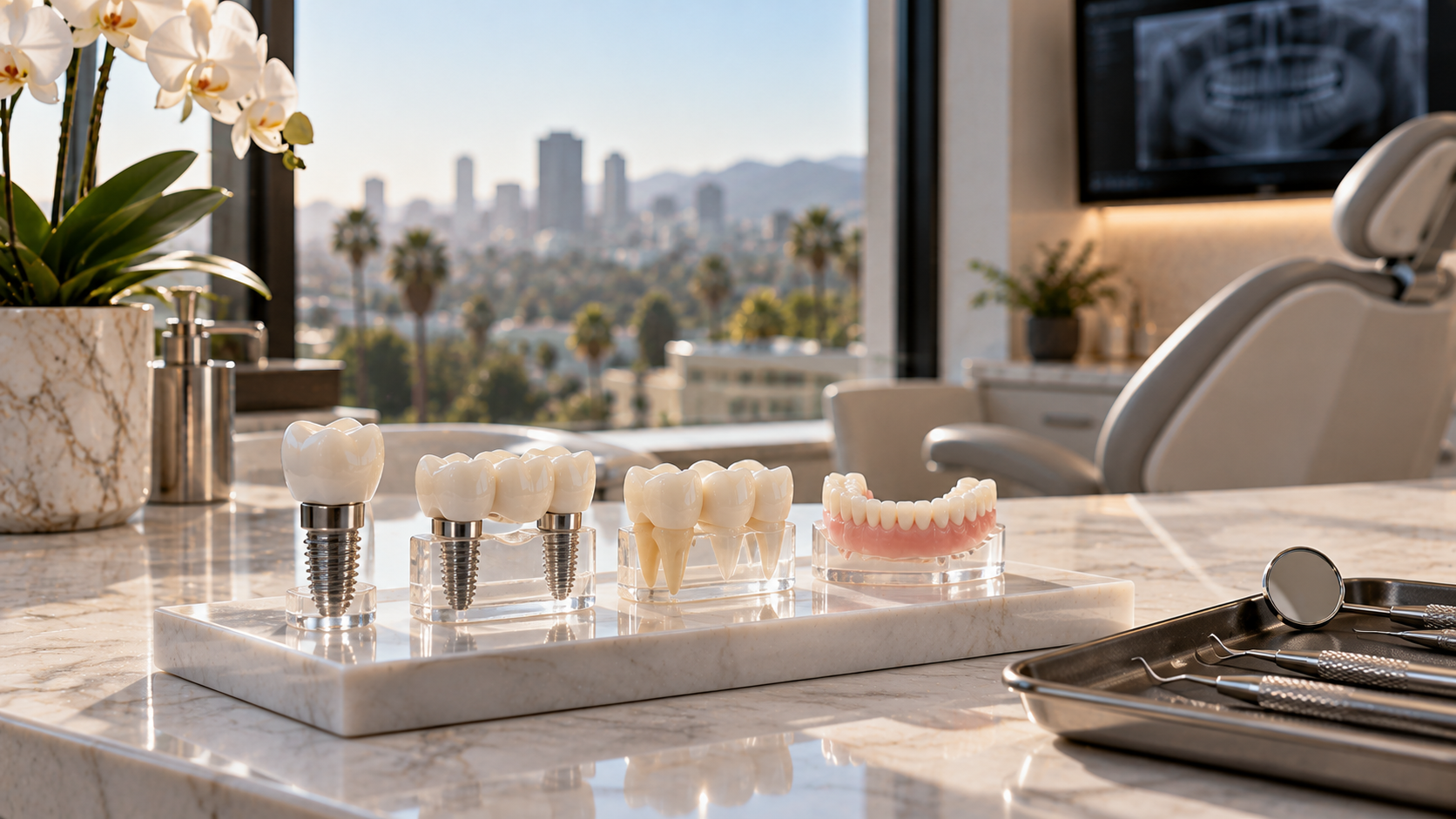
Tooth replacement options in Beverly Hills include dental implants (single, multiple, or full-arch), implant-supported bridges, traditional fixed bridges, removable partial dentures, and full dentures. Dental implants are the only option that replaces the tooth root, preserving jawbone density over time. The right choice depends on bone volume, the number of missing teeth, overall health, and long-term goals.

Key Takeaways

  • Dental implants are the only tooth replacement that prevents jawbone loss because they stimulate the bone the way a natural root does.
  • Full-arch implant solutions like All-on-X replace an entire jaw with four to six implants, making them a fixed alternative to dentures.
  • Bone volume determines which options are available to you before anything else is decided.
  • Patients on GLP-1 medications, those who’ve had cancer treatment, or those who’ve had weight loss surgery require a modified evaluation before implant placement.
  • A second opinion from a board-certified implantologist is worth getting before committing to any irreversible procedure.

Why Does the “Best Option” Vary So Much From Person to Person?

The answer most websites give you is a clean hierarchy: implants are best, bridges are second, dentures are last. That framing is too simple, and it skips the variables that actually change the answer. The real deciding factor isn’t the tooth. It’s the bone underneath it. When a tooth is lost, the jawbone beneath it begins to resorb because it no longer receives stimulation. A bridge spans the gap but leaves the bone untouched. A denture rests on the gum surface. Only an implant transmits chewing force into the bone, which is why implants are the only option that actively prevents the bone loss that makes future tooth replacement harder. This is the mechanism most comparison articles skip. The choice you make today shapes the options you’ll have in ten years.

What’s the Actual Difference Between Each Option?

Here’s a side-by-side comparison of the most common tooth replacement approaches, framed around what each one does and doesn’t protect:  
Option Replaces Root? Preserves Bone? Removable? Adjacent Teeth Affected? Typical Longevity
Single dental implant Yes Yes No No Decades with proper care
Implant-supported bridge Partially Partially No No Long-term
Traditional fixed bridge No No No Yes (filed down) 10-15 years average
Implant-supported denture Yes Yes Varies No Long-term
Full removable denture No No Yes No 5-8 years before refit
Partial removable denture No No Yes Yes (clasps) 5-10 years
The column that matters most to most patients isn’t longevity. It’s “adjacent teeth affected.” A traditional bridge requires grinding down two healthy teeth on either side of the gap to create anchor points. Those teeth are permanently altered. If you’re 40 years old and otherwise healthy, that’s a significant trade-off to accept when an implant avoids it entirely. You can explore the functional and cosmetic benefits of dental bridges to understand when that trade-off might still make sense for your situation.

Who Actually Qualifies for Dental Implants, and What Changes That Answer?

Most adults in good general health qualify. But “good general health” is doing a lot of work in that sentence. Several specific conditions change the evaluation: Bone volume. If significant bone loss has occurred since the tooth was lost, a bone graft may be needed before implant placement. This adds time to the process but doesn’t disqualify you. At Implant Dentistry by Doc Rok, 3D-guided imaging is used to assess bone density and map implant placement before a single incision is made. You can read more about how 3D-guided implant technology works in Beverly Hills and why it changes the accuracy of placement. Active gum disease. Placing an implant into a mouth with untreated periodontal disease is one of the most predictable ways to cause implant failure. The infection doesn’t stay contained. If you have gum disease, it needs to be treated first, often with LANAP laser periodontal therapy, before implant candidacy can be properly assessed. Systemic health factors. Patients who’ve had radiation to the jaw, those currently on certain medications, or those managing autoimmune conditions require a more careful pre-surgical evaluation. This is a category where the standard checklist isn’t enough. One scenario worth knowing about: patients who’ve had significant weight loss surgery often experience nutritional deficiencies that affect bone density and healing. The same is true for patients who’ve been on GLP-1 medications for an extended period. If that applies to you, the connection between GLP-1 medications and dental implant outcomes is something your provider needs to account for before treatment begins, not after. If you’re at this stage of research and want a clear picture of where you stand, the most useful next step is a consultation that includes imaging. Not a phone call. Not a quote. An actual evaluation. Schedule a consultation at Implant Dentistry by Doc Rok to get a treatment plan built around your specific bone structure, health history, and goals.

What If You’re Missing All or Most of Your Teeth?

Full-arch replacement is a different category than single-tooth replacement, and it deserves its own answer. All-on-X are implant-supported systems that replace an entire arch (upper, lower, or both) using four to six strategically placed implants. The final restoration is a fixed prosthetic, meaning it doesn’t come out at night. It functions like natural teeth. The contrarian reality of full-arch implants: most people who’ve been told they need dentures are actually candidates for a fixed implant solution. The assumption that full tooth loss means dentures is outdated. The real question is whether enough bone remains to support implants, and in many cases, the implants can be angled to use available bone even where density has declined. For patients who currently wear dentures and want to know whether conversion is possible, the full dental implant services page covers what the evaluation process looks like and what the transition involves.

What About Cosmetic Concerns Alongside Tooth Replacement?

Many patients coming in for tooth replacement also have concerns about the appearance of their remaining teeth. This is where the distinction between a dental implant practice and a full cosmetic practice matters. A single implant placed next to discolored or worn natural teeth creates a visible mismatch. The implant crown is fabricated to match your existing teeth, but if those teeth don’t reflect the smile you want, the result is a technically successful implant in an aesthetically incomplete smile. The most satisfying outcomes combine tooth replacement with a broader smile transformation plan. This might mean whitening or veneers for the surrounding teeth, or a full-mouth approach if multiple teeth are involved. Patients exploring these options often find that cosmetic dentistry in Beverly Hills can address the surrounding teeth alongside implant placement for a unified result. At Implant Dentistry by Doc Rok, these decisions are made together, not sequentially.

The One Mistake That Makes Every Option More Expensive

Waiting. Not because of price increases, but because of biology. Every month a tooth socket sits empty, the bone beneath it continues to resorb. What might be a straightforward implant placement today becomes a bone grafting case six months from now. If you’ve been told you need a bone graft, it’s worth understanding the signs that bone grafting may be necessary and what that process adds to your timeline. The most expensive tooth replacement decision isn’t choosing implants over a bridge. It’s delaying treatment until your options narrow.

Who Is NOT the Right Fit for Dental Implants Right Now?

Straight talk matters here. Implants aren’t the right immediate answer if you have active, untreated periodontal disease. They’re also not appropriate if you’re currently undergoing chemotherapy or radiation to the head and neck area, or if you’re a heavy smoker who isn’t willing to modify that habit during the healing period. Smoking significantly impairs osseointegration, which is the process by which the implant fuses to the bone. None of these are permanent disqualifiers for most people. But they are reasons to treat the underlying condition first. That sequencing is exactly what a thorough implant evaluation is designed to identify.

Frequently Asked Questions

How long does it actually take to get a dental implant from start to finish?

A straightforward single implant typically takes three to six months from placement to final crown, because the implant needs time to fuse with the bone before the permanent restoration is attached. If bone grafting is needed first, add another three to four months before implant placement can happen. Some cases qualify for same-day or immediate-load implants, but that depends on bone density and the specific tooth location.

Is the implant process painful?

Most patients report that the procedure itself is far more comfortable than they expected, because it’s done under local anesthesia and often with sedation options. The days following surgery involve soreness and swelling, not acute pain, and most people manage comfortably with over-the-counter medication. The anticipation is usually worse than the reality.

What happens if I already have bone loss from a missing tooth?

Bone loss doesn’t automatically rule out implants. A bone graft can rebuild the area before implant placement. The extent of the graft needed depends on how long the tooth has been missing and how much density has been lost, which is why imaging is done before any treatment plan is finalized.

Are full-arch implants really better than well-fitted dentures?

For most people, yes, and the reason is functional, not cosmetic. Fixed implant-supported arches allow you to bite with close to natural force. Removable dentures rest on the gum and shift under pressure, which limits what you can eat and accelerates bone loss beneath them. The long-term cost of dentures, including refits, adhesives, and eventual bone loss, often exceeds the upfront investment in implants.

What if I’ve already had a failed implant somewhere else?

A failed implant isn’t the end of the road. The cause of failure matters more than the failure itself. Infection, insufficient bone, and poor placement are all addressable. At Implant Dentistry by Doc Rok, patients seeking a second opinion on a failing or failed implant receive a full evaluation before any new treatment is proposed.

How do I know if my gum disease needs to be treated before I can get implants?

If you have bleeding gums, persistent bad breath, gum recession, or loose teeth, those are signs that active periodontal disease may be present. A proper evaluation will include measuring pocket depths around each tooth. Gum disease needs to be fully controlled before implant placement, because the same bacteria that destroy natural tooth roots can attack implant surfaces.

Does insurance typically cover dental implants in Beverly Hills?

Most traditional dental insurance plans classify implants as elective and provide limited or no coverage. Some plans cover the crown portion but not the implant itself. Financing options are available at Implant Dentistry by Doc Rok, and the insurance and financing page outlines what options exist for making treatment accessible without compromising on the quality of care. Your smile is the first thing people see and the last thing you should compromise on. If you’re ready to stop researching and start with a real plan, contact Implant Dentistry by Doc Rok for a consultation that takes your full picture into account, not just the missing tooth.

About the Author

Dr. Vivian Roknian, DMD, is a board-certified implantologist based in Beverly Hills with over 15 years of clinical experience and more than 10,000 implants placed. She has trained over 2,000 dentists nationally and internationally, with specialized expertise in complex cases including full-arch reconstruction, laser periodontal therapy, and patients with complex medical histories. Her practice, Implant Dentistry by Doc Rok, serves patients across Beverly Hills, Los Angeles, San Diego, and Santa Barbara.
Click to listen highlighted text!